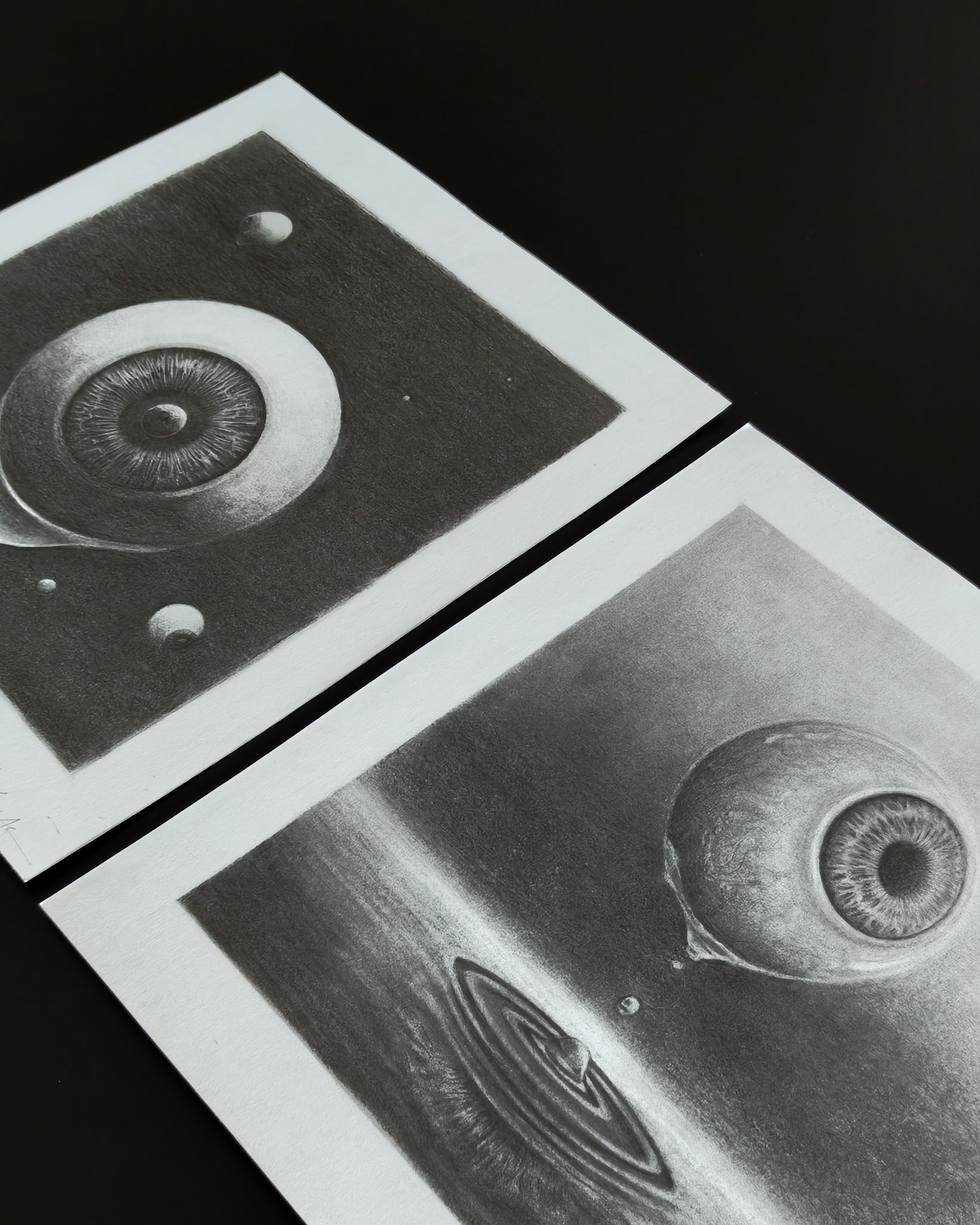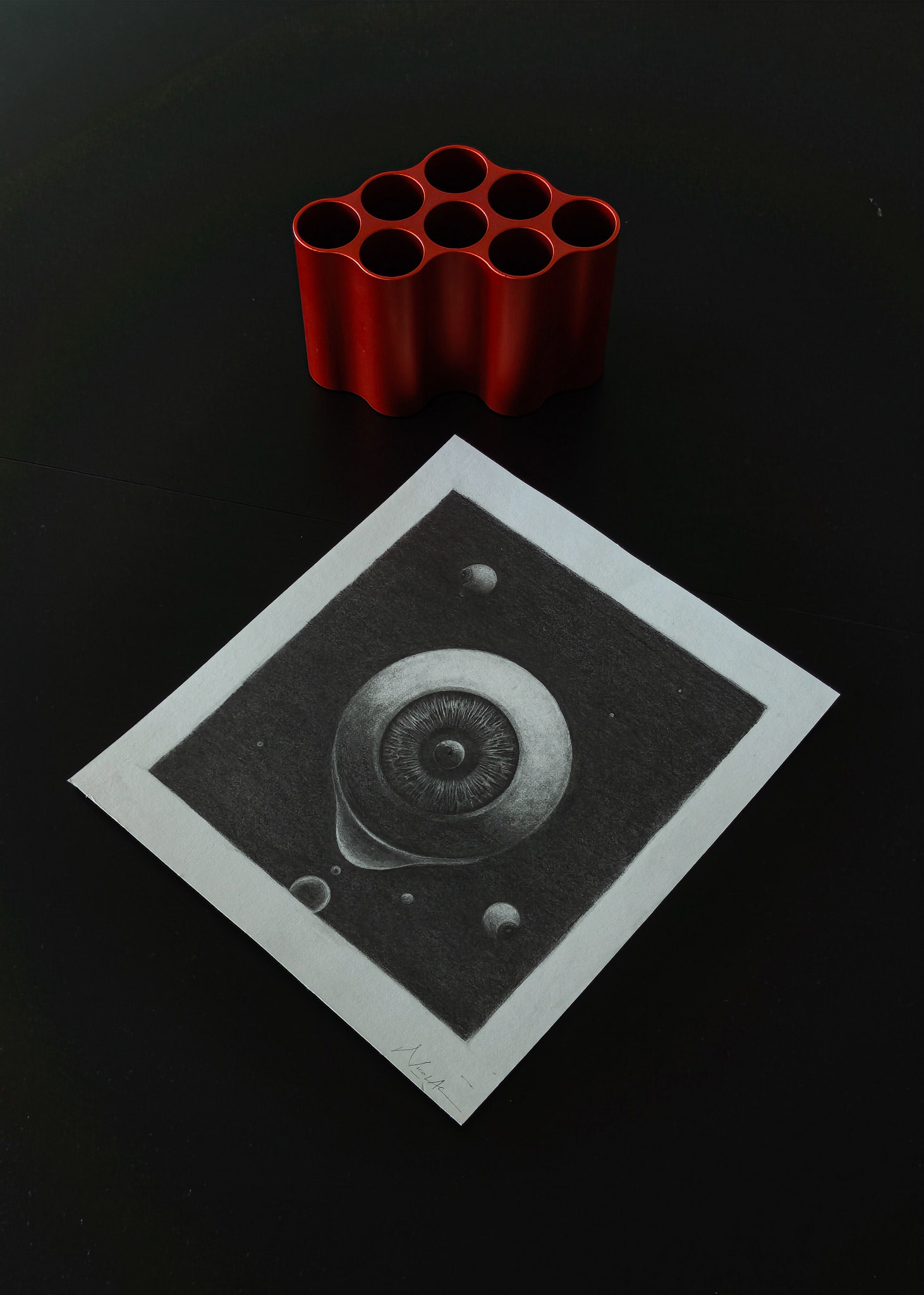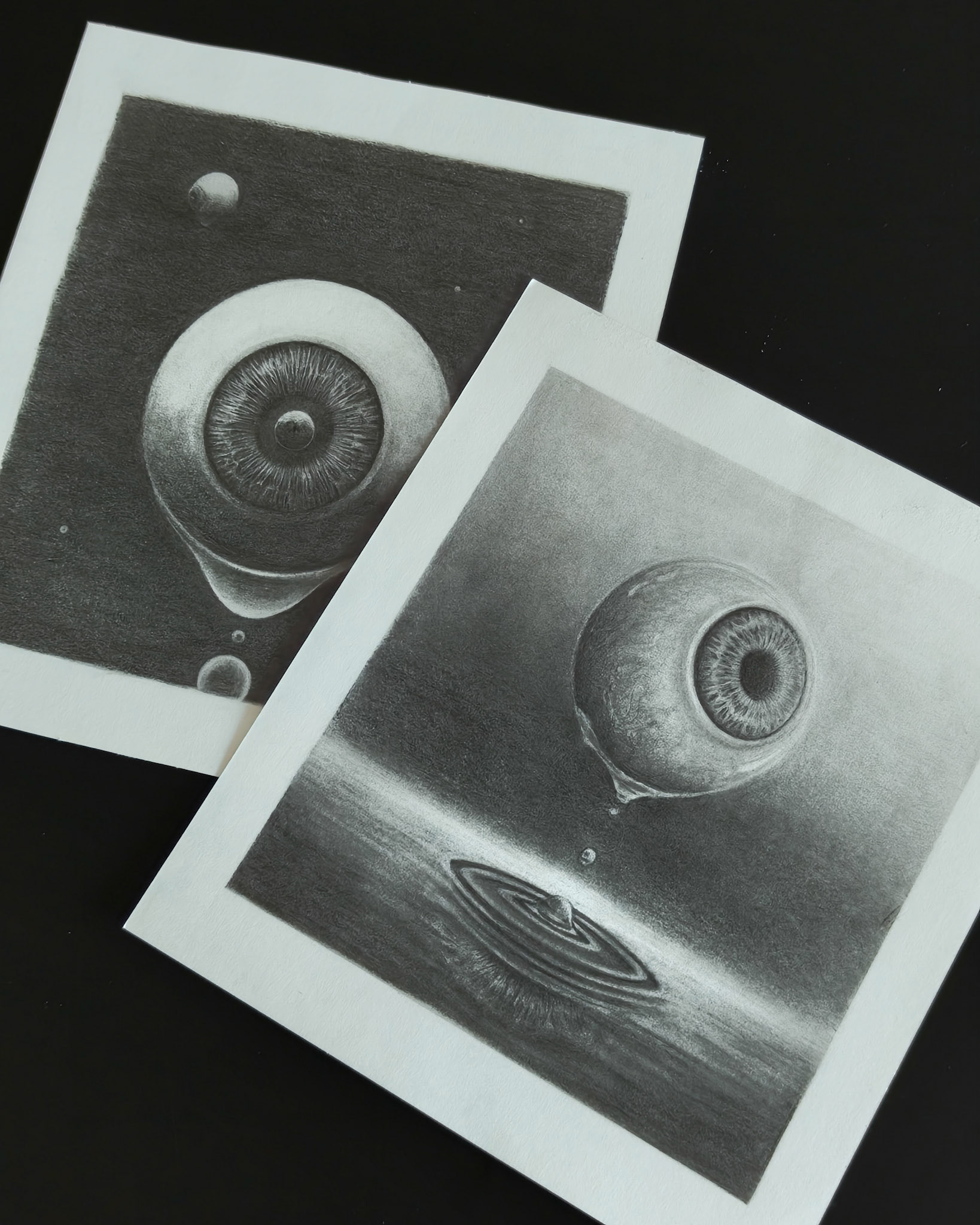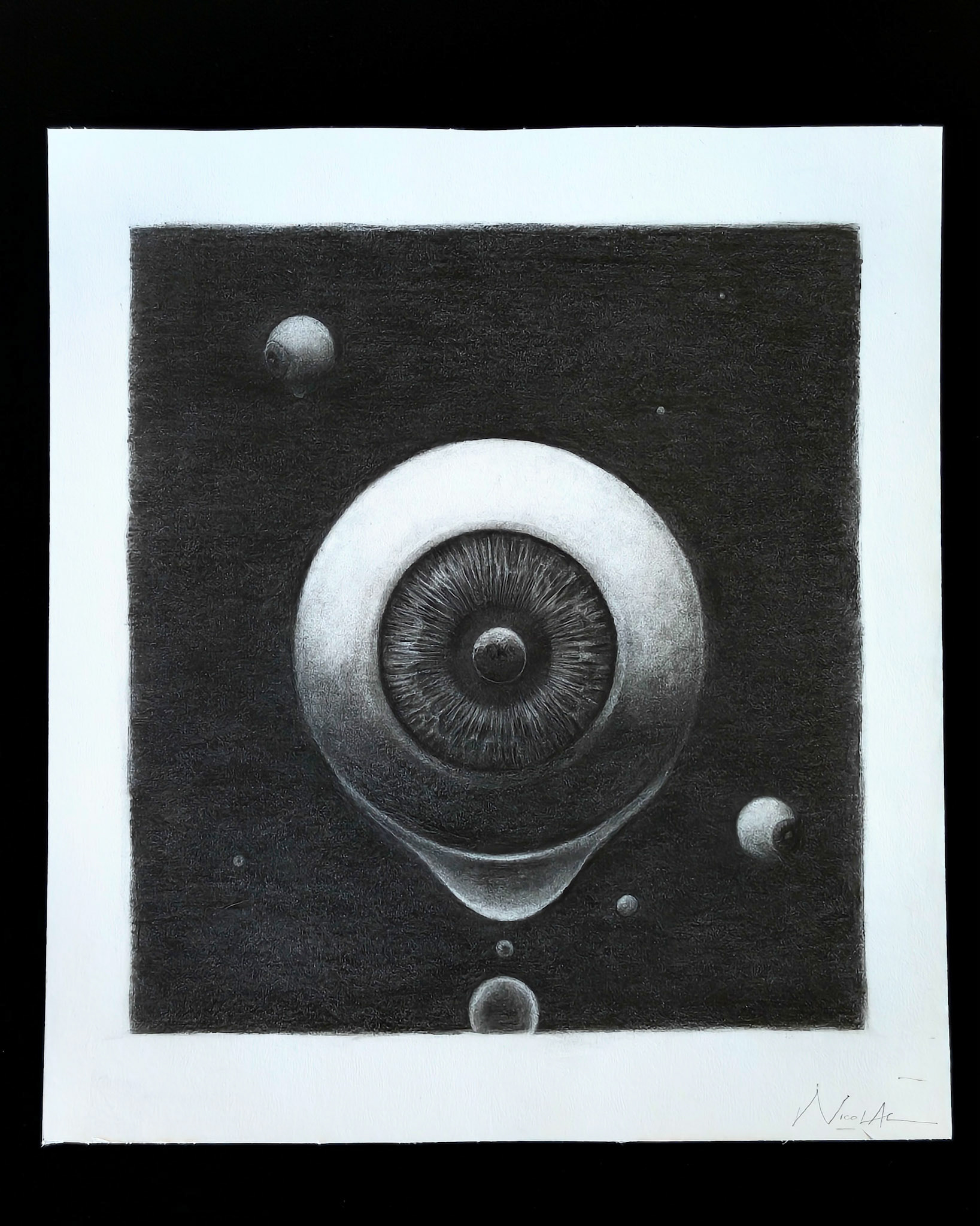
Idiopsis I
Graphite on paper, 2025
30 x 30 cm
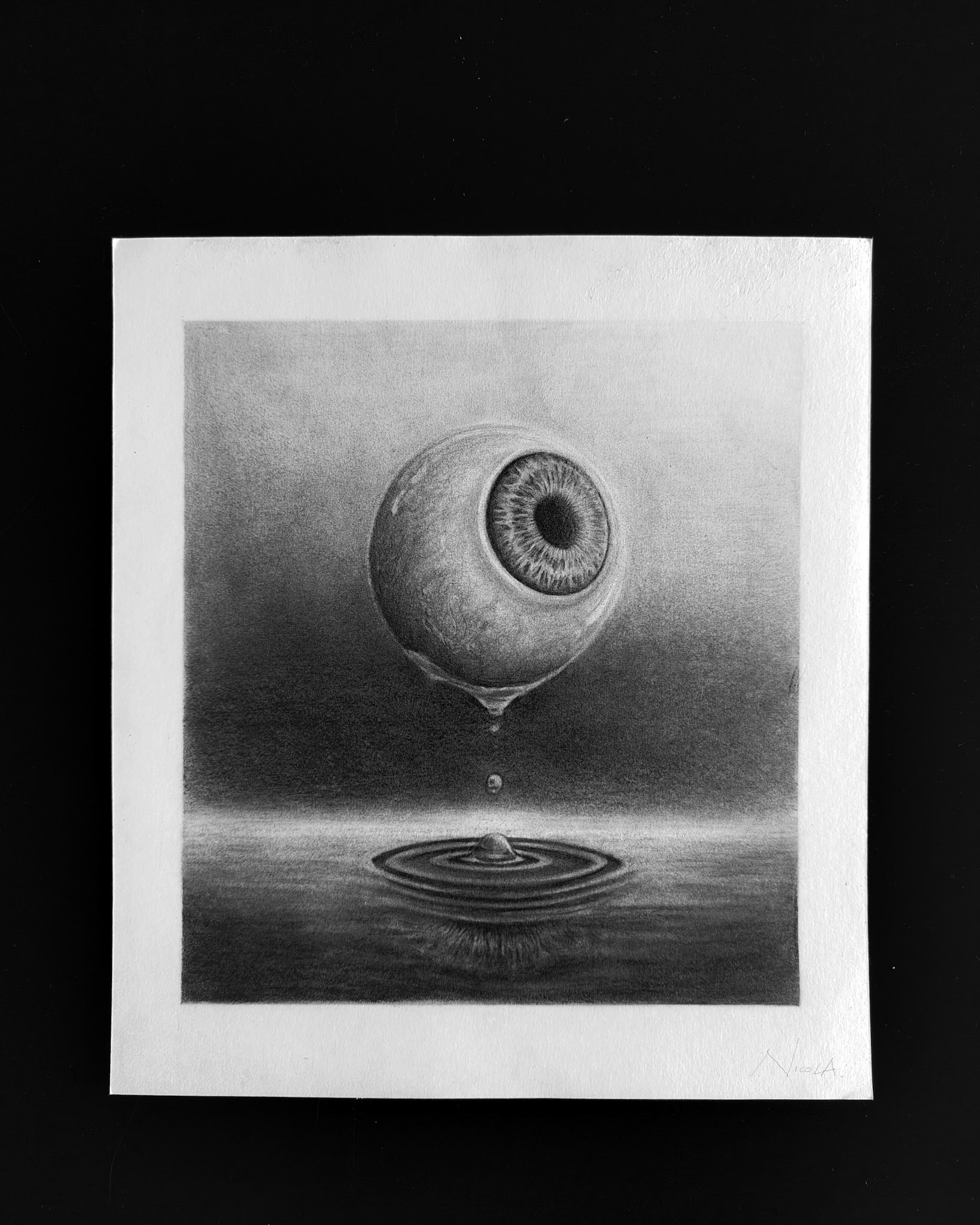
Idiopsis II
Graphite on paper, 2025
30 x 30 cm
From the Greek ídios (one’s own, private) and ópsis (vision), idiopsis names a perception that is radically subjective: a way of seeing that belongs exclusively to the individual, inaccessible to others: an inner optics through which reality is continuously rewritten.
The diptych articulates this condition through two complementary states.
Idiopsis I represents the coexistence of multiple inner worlds. The floating eyes do not observe the same reality; each contains a world unto itself. They hover in proximity yet remain sealed, autonomous. At the base of every internal world rests a tear—an essential, irreducible core of pain. This pain is not dramatic or externalized; it is structural. It sustains the world above it, suggesting that suffering is not an exception to subjectivity but one of its founding elements. The image holds these worlds together without merging them, affirming simultaneity without communion.
Idiopsis II introduces a shift in depth. Here, a single eye emerges from a stagnant body of water, as if surfacing from within its own interior landscape. The eye appears to be lacrimating, but the tear is no longer contained—it threatens to dissolve into the surrounding medium. Beneath the surface, a second eye is faintly visible, submerged, watching from below. This duplication suggests layers of perception: the eye that sees, the eye that is seen, and the eye that remains trapped beneath consciousness. Pain, in this image, is no longer foundational but cyclical—rising, sinking, re-emerging.
Together, the two works trace a closed system of subjectivity. Idiopsis I asserts the multiplicity of isolated inner worlds; Idiopsis II exposes their depth and recursion. What they share is not a common vision, but a common impossibility: no eye can fully reach another, and no pain can ever be entirely shared.
Everyone’s own world, everyone’s own pain becomes not a statement of pessimism, but a precise description of human perception—where seeing is always solitary, and meaning is always borne alone.